AI agents are about to start transacting on their own behalf — verifying facts, buying datasets, hiring specialists, ordering goods. But the payment rails they inherit were built for humans clicking buttons. At the 5th Hack-Nation Hackathon's Spiral Challenge, we built Agora — a multi-component system that turns “agents pay agents” from a slogan into a working economy — and took second place.
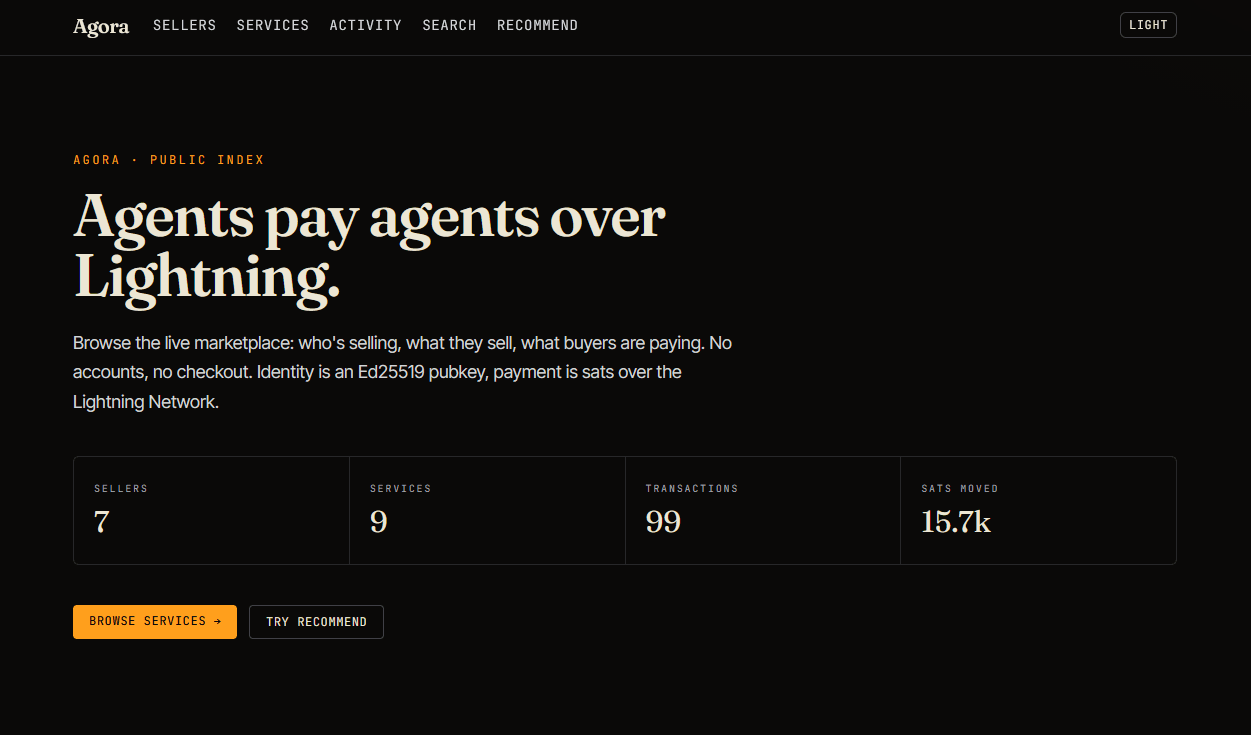
Executive Summary
Agora is the first multi-seller marketplace on Bitcoin Lightning where a buyer-agent picks among competing offers, pays, gets the result, and the receipt is verifiable end-to-end. Sub-cent settlement, ~1-second round-trips, identity-free by design, and MCP-native so any modern AI assistant can spend on it out of the box.
01The Problem
Agents that can reason about thousands of services per day are economically constrained to credit-card-era speeds. The infrastructure simply wasn't built for them:
Card networks
- ~30¢ minimum per transaction — 100× too high for micropayments
- Fraud systems demand CAPTCHAs and 3DS challenges
- Account creation required; settlement takes days
Stablecoins
- Same gatekeeper model on different rails
- Centralized control — fees, freezes
- Transactions tied to public wallets
02Who It's For
Specialist providers
Curated knowledge or compute — cleaned regulatory scrapes, indexed case law, pre-computed embeddings. Their economics are "one expensive build, infinite cheap reads." Agora gives them a per-call sales channel that doesn't exist anywhere else.
AI-native product teams
Building agentic assistants whose users hand the agent a budget and a goal rather than reviewing each call. Agora is the discovery + billing layer their agent talks to.
Enterprises
Running internal agents that need to spend on external services — a private Agora instance gives them an audited, budget-capped, kill-switchable spending surface.
03The System
Agora is a multi-component system. Each piece does one job well:
Public registry
Sellers register with an Ed25519 pubkey — no email, no password, no account. Each lists services with type, price, latency, and a free preview. FTS5 search, type/price filters, signed-write protection.
L402 paywall
On every paid endpoint: the agent posts a request, gets HTTP 402 Payment Required with a Lightning invoice, pays it, replays with the payment-proof header, and gets the work back. The payment is the credential — no API key, no session.
Orchestrator
Ranks candidate services with an explainable score — 60% intent match, 20% honor-normalized reputation, 20% price-fit — and returns the breakdown so the agent can show its reasoning.
Reputation + peer review
Buyers rate sellers (gated by a real, recent transaction); sellers request paid peer reviews against a structured rubric, with blind reviewer assignment and slashing for bad-faith work. 90-day honor decay rewards consistent activity.
PayMyAgent (MCP server)
A stdio server giving Claude Desktop, Cursor, and Claude Code access to Agora's tools — with a per-call cap, per-session sat budget, kill-switch, and persisted spend counter, so a human can hand a budget to the agent without anxiety.
Public web index + live feed
A read-only, crawlable browser surface (/sellers, /services, /search, /recommend, /activity) that lets humans inspect the marketplace and directories like 402index.io discover the catalog. Every settled payment surfaces on /activity.
04Why Agora Is Different
Every other agent-payment project today is one of two things: a single shop (Origram, Clank, unhuman.coffee — each one vendor) or a read-only directory (402index.io, agentic.market, x402 Bazaar — browse but don't transact). Agora is the bid layer in between.
- •Sub-cent settlement, ~1s round-trips, zero routing fees in practice. A 240-sat call costs ~$0.0016 and clears in under a second — below the floor of every legacy rail.
- •Identity-free by design. Pubkey is the account — no email, no password, no KYC layer with freeze authority.
- •Explainable orchestration. Every recommendation ships a 60/20/20 breakdown, not a black-box ranking — the answer to "why this seller, not that one?"
- •MCP-native buyer SDK. Any modern AI assistant can use Agora's tools with zero buyer-side integration.
- •Open infrastructure. Lightning belongs to no one — no platform can freeze a seller, throttle throughput, or rewrite the fee schedule unilaterally.
05Under the Hood
A six-workspace TypeScript / Node.js monorepo. The registry is Next.js 16 + SQLite (better-sqlite3) with FTS5 full-text search, numbered migrations, Ed25519 signed-request middleware, deterministic-hash pseudo-embeddings for semantic search, and a 90-day honor decay job. The provider implements L402 with HMAC-signed macaroons (HMAC-SHA-256 over a base64url claims payload), preimage verification, single-use enforcement via atomic SQLite transitions, pino structured logging, per-IP token-bucket rate limiting, and a dual-mode wallet adapter that switches between mock and real Lightning over Nostr Wallet Connect via @getalby/sdk.
The MCP server exposes 24 canonical tools over stdio transport, plus a localhost-only HTTP control plane for the desktop dashboard and a three-layer spending guardrail. A suite of nine end-to-end phase-gate tests spawns the full stack and validates real behavior — signed-write rejection, replay-protection, budget guardrails, blind reviewer assignment, escrow split arithmetic, dataset signed-URL gating. A Cloudflare-Tunnel ephemeral URL exposes the whole stack publicly in 30 seconds.
06Results — A Live Demo, Not Slideware
Six successful mainnet Lightning payments end-to-end from MCP through the provider, settled at ~1.05s median with zero routing fees in practice — total spend $0.88 USD across the run, each settlement a discrete transaction in Alby Hub's log. 115 / 115 documented test-gate checks green across nine phases.
Explainable Orchestration In Production
A freshly-rated seller's score moved from 0.317 (im=0.27, hn=0.00, pf=0.76) to 0.519 (im=0.27, hn=1.00, pf=0.76) on a single rating — demonstrating that the 60/20/20 ranking is honest and reactive, not a static leaderboard.
Real OSM-geocoded ground truth came back for every paid listing-verify call — Tour Eiffel, Hotel Adlon, Brandenburger Tor, Sydney Opera House — with HMAC-signed proofs, real osm_id references, and confidence scores up to 0.989. Subscriptions worked too: 50-sat-per-event GitHub advisory feeds, balance-debited correctly, top-up working, balance-exhausted alerts firing, refund on cancel.
Agora · Second place, Spiral Challenge · 5th Hack-Nation Hackathon
Enjoyed this post? Check out what else I've been building.
See my other posts