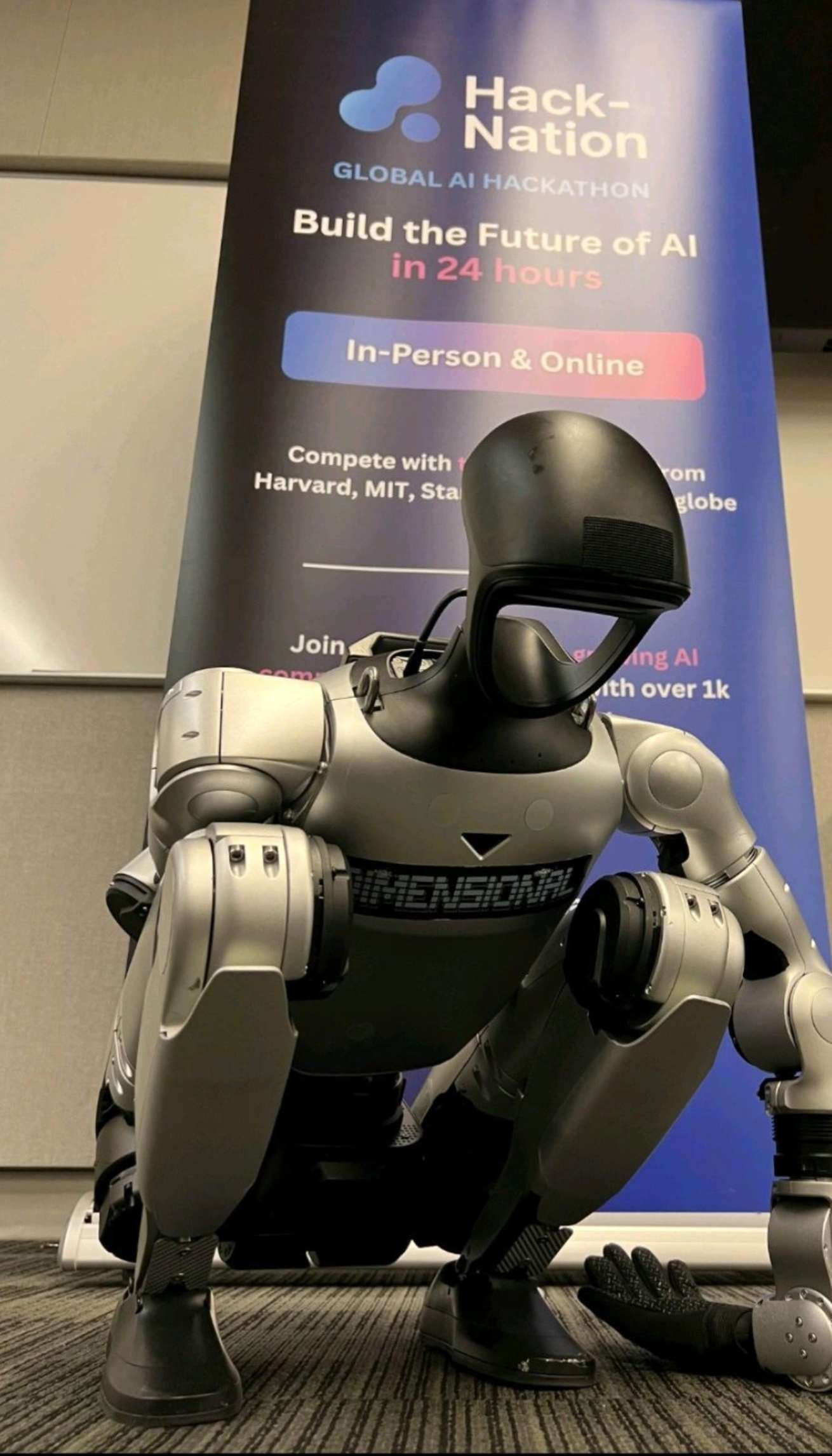
Somewhere between imagining a clenched fist and watching a simulated robot turn right on a factory floor in Munich, it clicked. This was real. We were doing it. At the MIT Hack-Nation Global AI Hackathon, we built ThoughtLink — a brain-to-robot interface — from scratch in 18 hours, and walked away with first place in the Neuro-Robotics VC track.
01The Arena
Hack-Nation's Global AI Hackathon is not your average weekend event. Over 1,500 participants from Harvard, ETH Zürich, MIT, Stanford and beyond converged across global hubs — our team stationed in Munich — for a single weekend of building under pressure. Twelve tracks, each sponsored and judged by a VC firm with skin in the game.
We picked the Neuro-Robotics track, backed by Dimensional and Kernel, with a challenge that read almost like science fiction: build an interface that maps EEG brain signals to the control of humanoid robots.
The Challenge
Factory operators directing humanoid robots are burdened by joysticks and scripted programs — slow, line-of-sight dependent, hands-occupied. EEG offers hands-free control, but decoding motor imagery from a low-density 6-channel headset into reliable real-time commands remains unsolved. Build the interface. Close the loop.
02The Constraint We Didn't Flinch At
There was one significant catch. At the Munich hub, we had neither a real EEG headset nor a physical humanoid robot to play with. No Kernel Flow. No Unitree G1 standing in the corner. Just three people, our laptops, and a ticking clock.
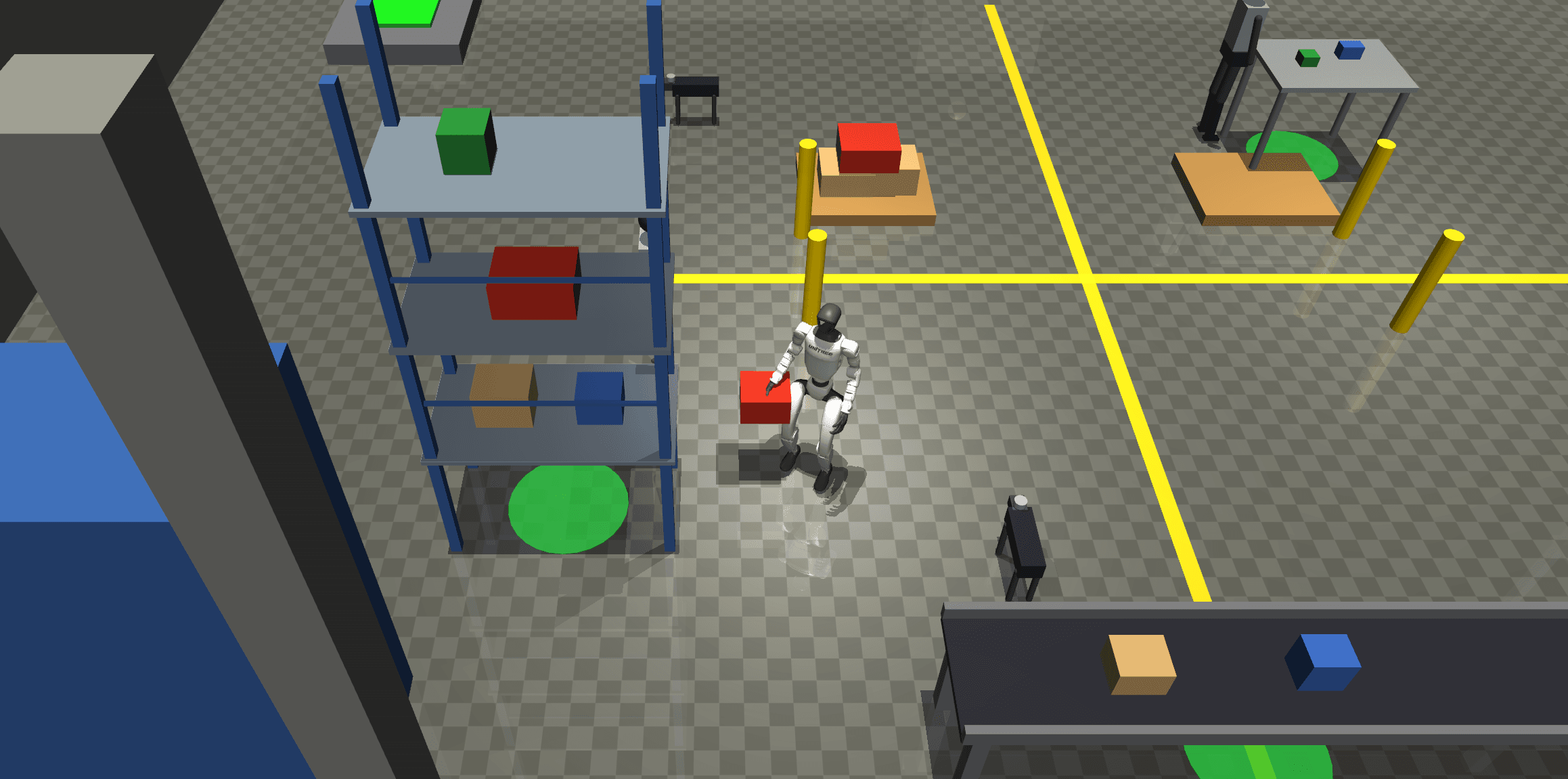
We didn't treat this as a blocker. We trained our ML model on sample EEG datasets and built a full MuJoCo physics simulation of the factory environment. The constraints forced clarity.
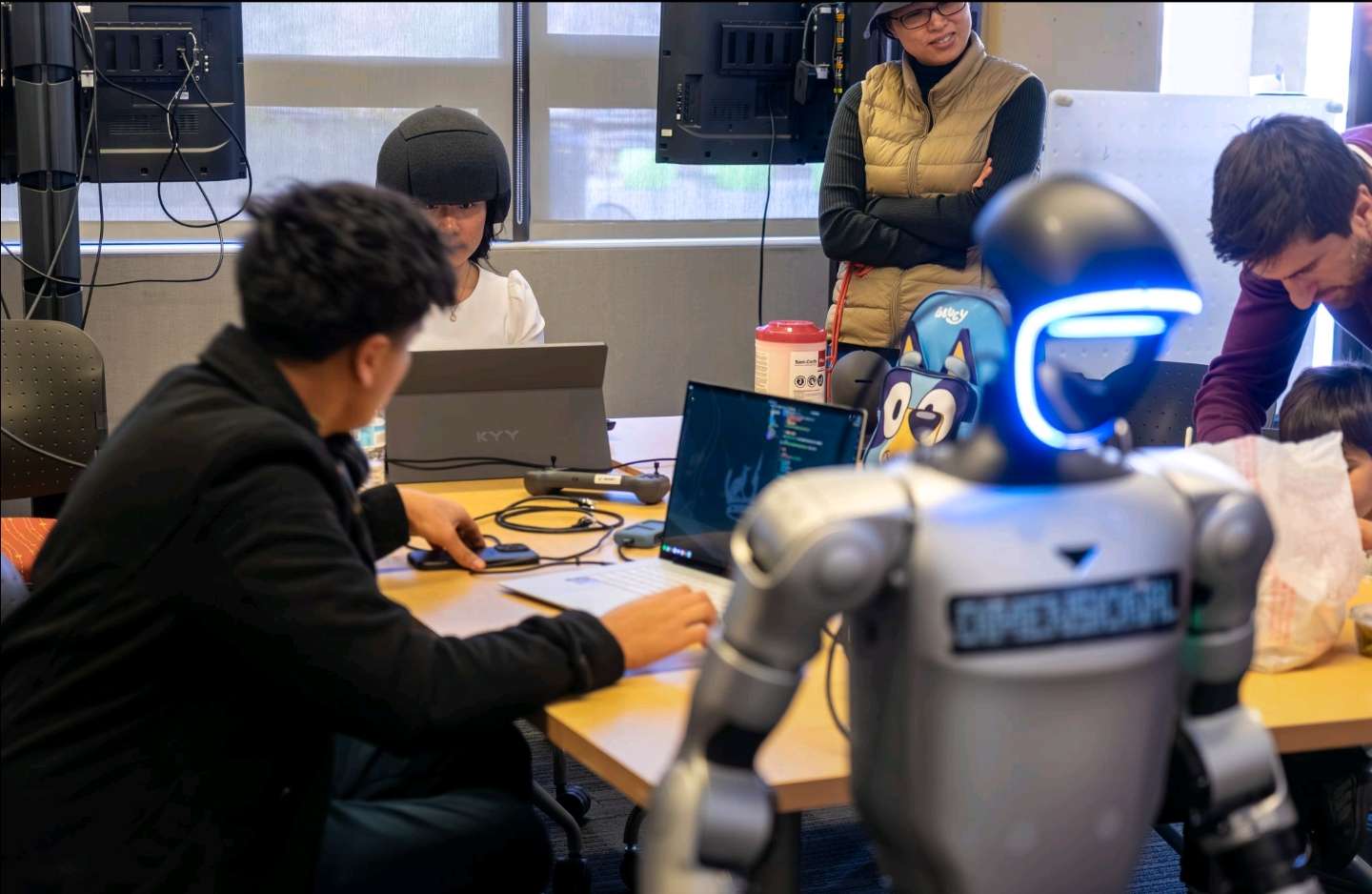
03The Team
Joshua
Interface · UI/UX · Control Scheme Design
Mourad Ouazghire
Robotics Simulation · MuJoCo Integration
Dimitrii Fadeef
ML Pipeline · Voice Backend
Mourad was exceptional. His background in robotics meant we had someone who genuinely understood the simulation side of things, which let me focus on where I could contribute most — design systems, interaction models, and the kind of creative problem-solving that comes from too many hours in game engines.
04What We Built
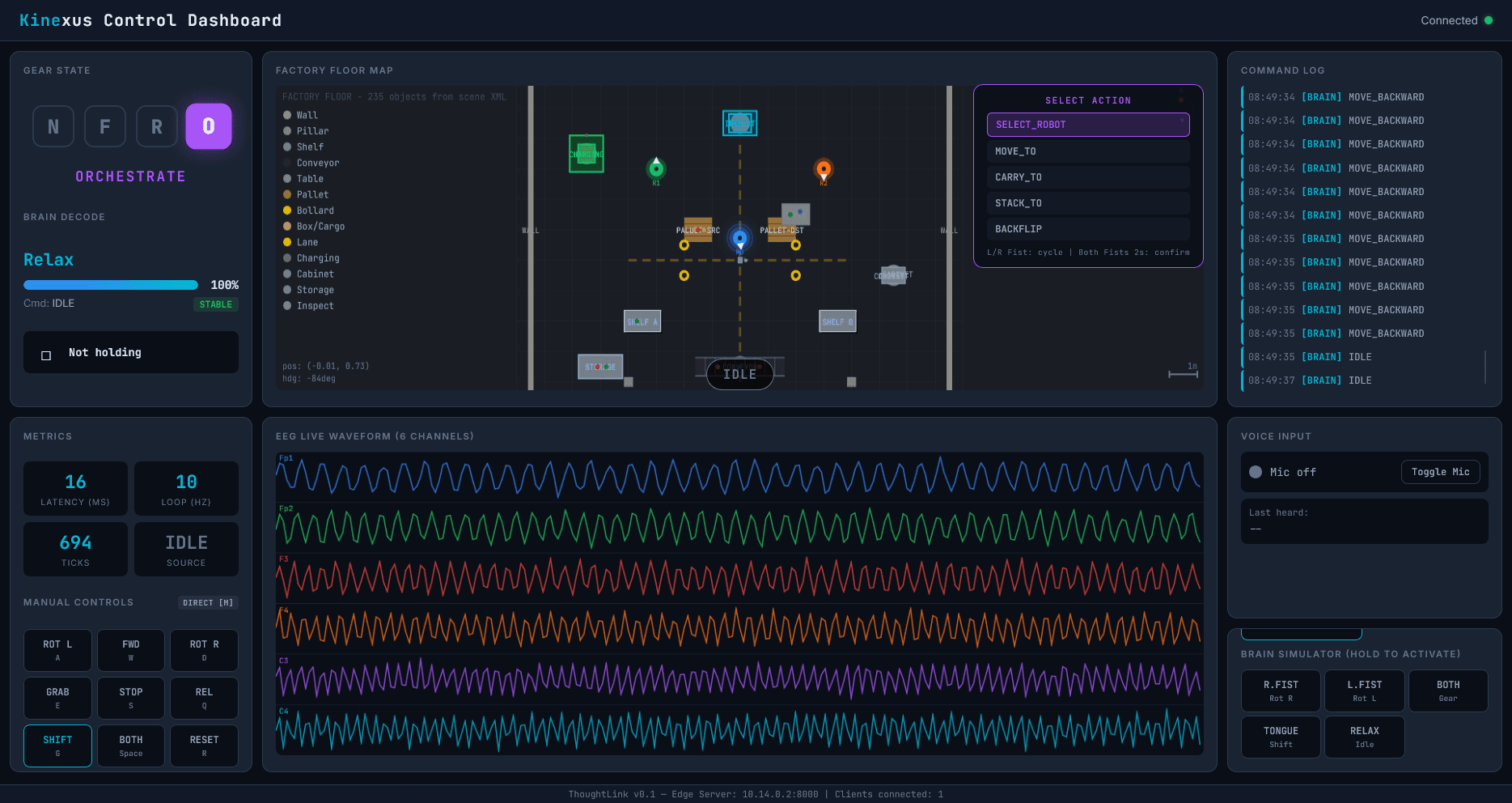
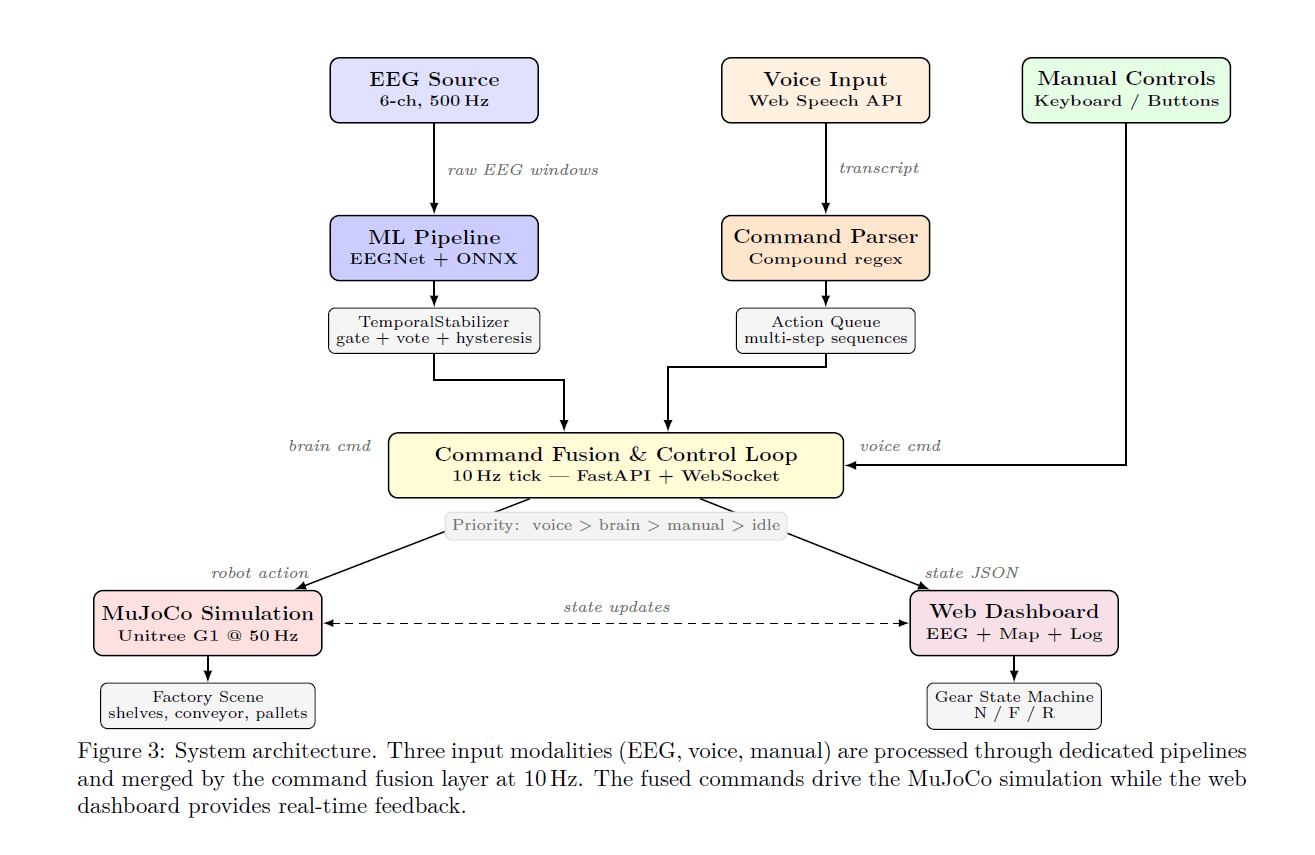
ThoughtLink is a multimodal brain-to-robot control system. At its core, an EEGNet model (just 12.6K parameters, exported to ONNX for 0.46ms inference) decodes five motor-imagery classes from 6-channel EEG in real time. A FastAPI backend with a 10Hz WebSocket control loop bridges the signal processing to the simulation. Voice commands handle complex multi-step instructions in natural language. And a single-page vanilla JS dashboard ties it all together.
05The Gear System — The Part I'm Most Proud Of
With only five raw inputs, designing an expressive control system felt like a puzzle. The breakthrough came from an unexpected place: manual transmission.
“A car with a gear stick doesn't need a different button for every possible speed. It uses a small set of inputs — gear selection, throttle, steering — to express infinite variation. The same principle should apply here.
Gear 1 / 2
Forward · Reverse
Robot moves in the selected direction. Left/right fist controls turning while in motion.
Gear 3
Neutral
Robot is stationary. Both fists triggers the end-effector — grab in neutral forward, release in neutral reverse.
Gear 4 — The Interesting One
Orchestration Mode
For complex, preprogrammed multi-robot instructions. A nested menu system is navigated entirely with fist gestures: left/right fist scrolls through options, a held double-clench confirms, a rapid double-clench goes back up the menu. Multi-robot selection also lives here.
The gear metaphor gave the whole system coherence. It's modular, extensible, and — critically — learnable. A factory operator could train muscle memory for this just as naturally as they learned to drive.
06The Numbers
The accuracy numbers are honest. 35.2% over a 5-class problem is nearly double chance — but it's not production-ready EEG classification, and we weren't pretending otherwise. The more telling metric is that the closed-loop system was stable. Brain signals in, robot moves out, within two seconds, repeatedly, without crashing.
07First Place. And Then the Finals.
We won the Neuro-Robotics VC track. Ranked #1 out of all teams in our challenge, amongst 1,500 participants from some of the world's most storied institutions. I won't pretend that didn't feel surreal.
The final cross-track pitch round was a different story. Two minutes. Every team from every track. We didn't place.
Honest Reflection
Two minutes is not enough time to both demo a live BCI system and explain the architecture. In hindsight, we should have decided in the first thirty seconds of prep which one we were doing. We tried to do both. That's not a technical failure — that's a pitching one.
Being in that finals room, pitching alongside people from MIT, Stanford, and ETH Zürich, was genuinely humbling. I was grateful just to be there. And we held our own in the track that mattered.
08What I'd Do Differently
On the product: The gear system is solid, but it's a foundation, not a ceiling. I'd want custom command sets that operators define themselves. More motor-imagery classes trained on real user data. And the dashboard deserves an AR layer: a spatial overlay of the factory map.
On pitching: Decide in the first minute what story you're telling. The story was simple: imagine you run a warehouse. You want to direct three hundred robots without putting down your tools. Think about clenching your fist. The robot turns. That's it. We over-complicated it.
09What I'll Take Forward
I came into this hackathon as someone whose expertise is not robotics or ML — it's interfaces, systems thinking, and the kind of problem-solving you develop when you've spent too long in game engines and manual-transmission cars. And I think that actually mattered.
The gear system wasn't designed by a roboticist. It was designed by someone who thought about how people learn physical control schemes, how context changes what a gesture means, and what it would feel like to teach a hundred factory workers a new interface. The best contribution you can make in a hackathon is the one that comes from your actual perspective.
Mourad and Dimitrii were outstanding. I was lucky to hack alongside them, and luckier still to be in a room full of people who pushed us to build something that, for at least one weekend, made controlling robots with your mind feel inevitable.
ThoughtLink · Built at MIT Hack-Nation Global AI Hackathon · Munich Hub · 2025
Enjoyed this post? Check out what else I've been building.
See my other posts